|
For this reason, at the
end of the seventies, the large antenna networks were conceived: the European
VLBI network and the American VLBA one. Simultaneously observing a source
with all the network elements, a “radio image” can be built,
such an image showing the same details that would have been obtained using
a filled-aperture antenna having the dimensions of the whole network!
The radiotelescope networks solved the problem about how to increase the
resolving power, allowing a very detailed study of the most distant radiogalaxies.
However, the virtual instrument sensitivity is still depending on the
geometric mean of all the single antenna areas.
As a consequence, the whole network is very directive but not sensitive.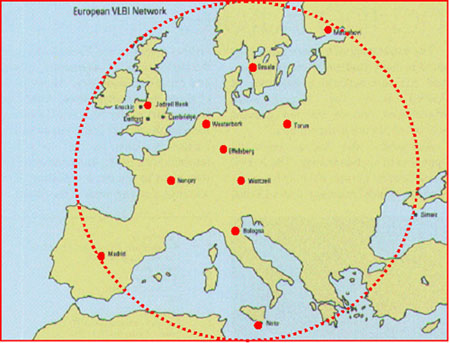
To obtain a fully effective
radiotelescope is then necessary to widen its collecting area; that’s
why a new radiotelescope concept is nowadays spreading: SKA (Square Kilometre
Array), a telescope having a total surface of 1.000.000 square metres.
SKA will
be built thanks to the efforts of many international Institutions and
Research Institutes. The further possible step will be to build a network,
following the present VLBI example, composed by several elements, each
having a surface of a square kilometre. Such a network will be characterised
by both a high resolving power and a high sensitivity. The
SKA project is now being discussed, and different technical solutions
are being proposed: parabolic, flat, spherical or parabolic-cylinder antennas
may be used to compose the array.
|